Management of change guidance across Australia's states and territories
Management of Change (MOC) is the record a site keeps when something on the site changes. The documents below are published by Australian regulators and governments. They are grouped by national material first, then by state and territory.
How Mocos lines up with ISO management systems
Mocos helps with the change-management parts of these standards. It does not certify a company, and it does not by itself achieve or ensure compliance.
- ISO 9001 clauses 6.3 and 8.5.6: planning of changes, and control of changes to production and service provision.
- ISO 14001 clauses 6.1 and 8.1: planning actions to address environmental aspects, and operational control when things change.
- ISO 45001 clause 8.1.3: managing planned temporary and permanent changes that can affect occupational health and safety.
The optional environmental impact note on a Mocos record is where a site can write how a change could affect the environment.
Starting point: WorkSafe WA Management of change guide
Management of change: guide, WorkSafe Western Australia (Department of Energy, Mines, Industry Regulation and Safety), 2024. This guide sets out the minimum parts of a management of change system: identifying and documenting a proposed change, evaluating its technical benefits and risks to worker health and safety, having a set authority review and approve it, then implementing, verifying and communicating it. It covers permanent, temporary and emergency changes, as well as operational, organisational and procedural changes, and gives particular attention to worker involvement, human factors, psychosocial hazards and keeping documents current. It was written for petroleum, pipeline and geothermal operations under WA's work health and safety laws, but its principles apply to any site handling hazardous materials.
National
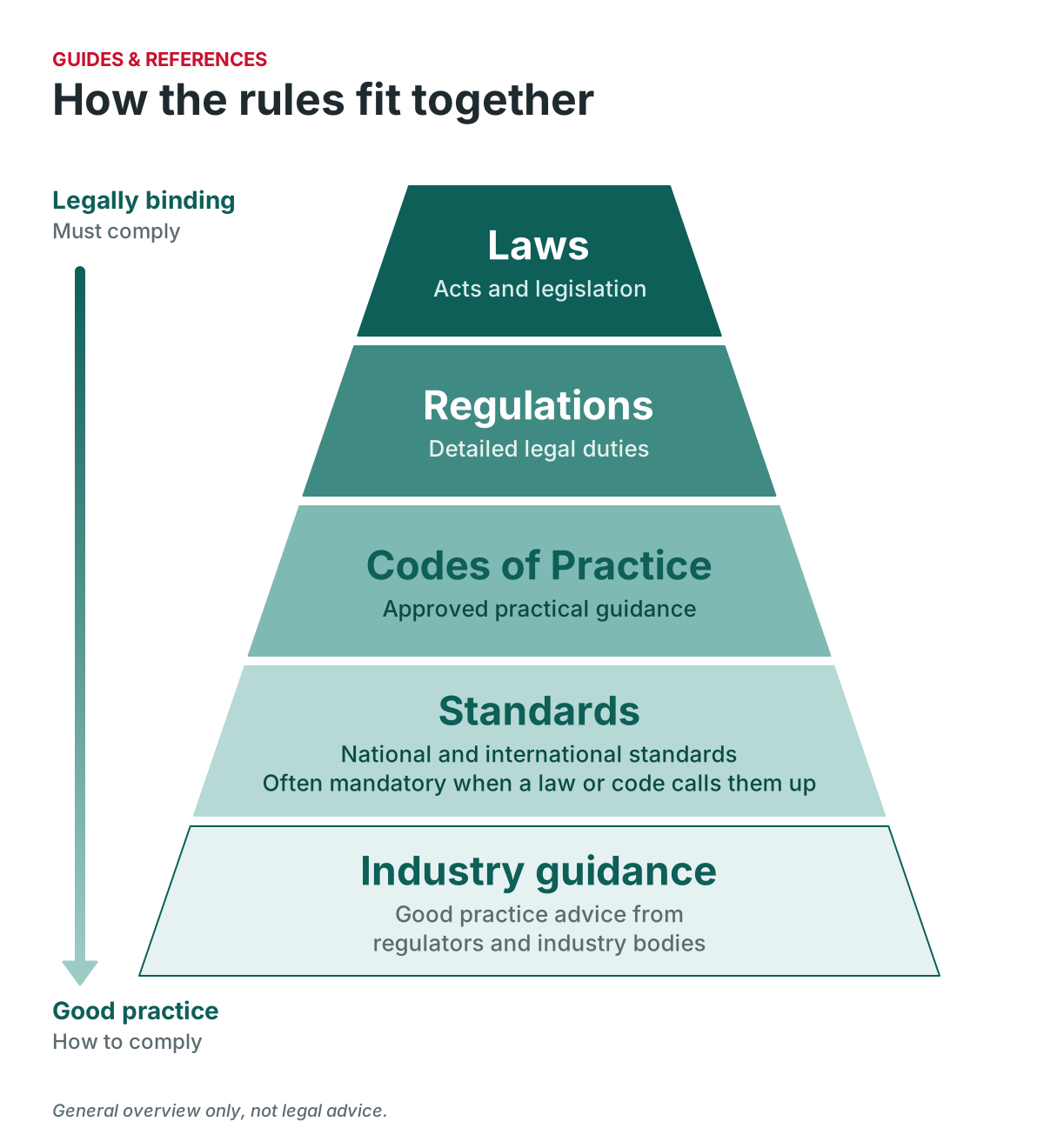
- Model Work Health and Safety Regulations, Safe Work Australia. These are the model rules for hazardous chemicals (Chapter 7) and major hazard facilities (Chapter 9) that most states and territories have adopted, including duties to review controls when things change.
- Model Code of Practice: Managing risks of hazardous chemicals in the workplace, Safe Work Australia. Practical guidance on identifying hazards, assessing risk and reviewing controls for hazardous chemicals, including when a change is made at the workplace.
- Model Code of Practice: How to manage work health and safety risks, Safe Work Australia. Explains the basic risk management process and when controls should be reviewed, which underpins any change process.
- Major hazard facilities, Safe Work Australia. Overview of major hazard facility duties, licensing, safety management systems and safety cases, with links to the full set of national guides.
- Guide for major hazard facilities – Safety management systems, Safe Work Australia. Describes what a major hazard facility safety management system must contain, including management of change.
- Guide for major hazard facilities – Safety case: Demonstrating the adequacy of safety management and control measures, Safe Work Australia. Shows how operators demonstrate their controls are adequate and kept up to date as the facility changes.
Western Australia
- Dangerous Goods Safety Act 2004, Parliamentary Counsel's Office WA. The main WA law for the safe storage, handling and transport of dangerous goods.
- Dangerous Goods Safety (Storage and Handling of Non-explosives) Regulations 2007, Parliamentary Counsel's Office WA. Sets out duties for dangerous goods sites, including risk assessment, the manifest and site plan, and reviewing risks when something changes.
- Dangerous Goods Safety (Storage and Handling of Non-explosives) Regulations 2007: Guide, WorkSafe WA. Plain-language guide to the storage and handling regulations, including risk assessment, change management and record keeping at dangerous goods sites.
- Preparing a safety report for a major hazard facility (MHF), WorkSafe WA. Explains the safety report, risk assessment and safety management system needed for WA major hazard facilities.
- Development and submission of a safety report: Guide, WorkSafe WA. Detailed guidance on what a WA major hazard facility safety report must cover and how it is kept current.
New South Wales
Victoria
Queensland
South Australia
- Major hazard facilities, SafeWork SA. SA duties for major hazard facilities, including notifying SafeWork SA of changes in chemical quantities and keeping the safety management system current.
Tasmania
- Hazardous chemicals, WorkSafe Tasmania. Explains duties for hazardous chemical and manifest quantity workplaces, including notifying WorkSafe of significant changes in risk.
Northern Territory
Australian Capital Territory
- Hazardous chemicals, WorkSafe ACT. ACT guidance on hazardous chemicals duties, manifests and notifications.
- Dangerous Substances Act 2004, ACT Legislation Register. The ACT law covering dangerous substances such as explosives and security-sensitive substances.
Offshore petroleum (Commonwealth waters)
- Safety management systems guidance note, National Offshore Petroleum Safety and Environmental Management Authority (NOPSEMA). Explains management of change as an essential part of a safety management system and warns against using it to make permanent departures from an accepted safety case.
- Safety case lifecycle management guidance note, NOPSEMA. Explains which changes can be handled through a site's own change process and which must trigger a formal safety case revision.
Disclaimer
This list is general information only and is not legal advice. Laws, regulations and guidance change, and requirements differ between states and territories. Operators should check the current version of each document with their regulator and get professional advice for their own site. Mocos is a tool to help record and manage changes; it does not replace an operator's own legal duties.